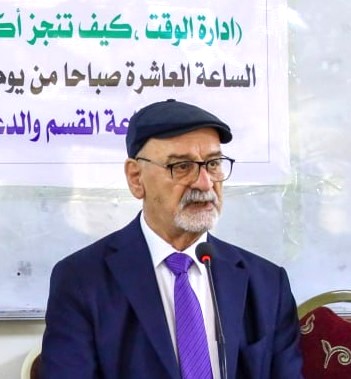
Participation of a faculty member from the Arabic Language Department in an international conference
22/10/2025
With Artificial Intelligence
29/10/2025I will present my answer in an introduction, body, and conclusion.
In the introduction, I go beyond defining methodology as a set of steps to achieve a goal, and beyond the relationship of modern Arab criticism to modern Western methodologies. I also go beyond Dr. Salah Fadl’s classification of this relationship into three generations: the first generation of professors, the second of literary critics, and the third of modernist critics, as stated in his book “Contemporary Critical Methodologies and Terminology, Merit Publishing, Cairo, 2002” pp. 178-202. Dr. Sayed Al-Bahrawi was searching for methodology, so he titled his book [The Search for Methodology in Modern Arab Criticism, Sharqiyat Publishing, Cairo, 1993], as did Dr. Saleh Huwaidi, who divided modern critical methodologies into external methodologies, such as historical, psychological, and social approaches, and internal methodologies, such as formalism, new criticism, structuralism, and deconstruction. [Literary Critical Methodologies, Questions and Approaches, Nineveh Publishing, Damascus, 2015] pp. 69-132.
Similarly, the topic “Arab Interaction with Contemporary Western Criticism” in [The Literary Critic’s Guide, Arab Cultural Center, Beirut, 3rd edition, 2002] pp. 363-405. And many other examples indicate a new history of Arab criticism, and we continue one of its episodes.
As for the body, it is my testimony on the subject of “The Methodology Question” in literary criticism. Methodology is a question in terms of the necessity for critical analysis to be based on a methodology, or specific procedures, carried out by the critic to reach a conclusion or achieve a goal. What do our studies gain from following Western methodologies? This is what we address in the body.
On Arabic Rhetoric and Stylistics
The doctoral thesis was based on studying style from rhetorical inimitability, benefiting from the Arab-Islamic heritage in monitoring the discrepancy between the style of the Holy Quran and human styles in poetry and prose. It employed many ideas and concepts in elucidating the characteristics that distinguished and uniquely characterized the style of the Holy Quran, following the modern stylistic approach in doing so.
Here, it is necessary to point out that we considered the specificity of research in the Holy Quran as it is the speech of a speaker unlike other speakers, so we did not address this, to the originator, and confined ourselves to the text and its recipient.
Then, reading Arabic rhetorical topics, especially the rhetoric of the Holy Quran, with a contemporary stylistic understanding, does not mean projecting modern concepts onto old facts, as much as it means re-studying the old and developing its aspects suitable for contemporary study. This involves investment, development, and progress on the path of research that takes from the old as it takes from the new, thus renewing research and making it compatible with an inherently renewable field. By this, we mean the flexibility of rhetorical inimitability and its capacity for original ideas. [Style in the Rhetorical Inimitability of the Holy Quran: 12. Libya published in 1997, another edition in 2008, and a Persian translation was published in Tehran in 1384 AH, then the book Stylistics, Concepts and Applications was published in 1997 by a university and adopted as a curriculum in universities].
Quranic Sciences, Orality, and Literacy
Anthropology studied primitive societies and analyzed the relationship between the method of acquiring knowledge and the pattern of thinking in them, comparing those societies with modern society that possessed means other than oral communication to acquire its knowledge, and thus for the emergence of a pattern of thinking different from that of primitives. From here emerged research specializing in studying patterns of thinking in different societies, trying to reach a description of the mind according to the outputs of its culture, classifying it into two types: an oral mind and a written mind. The first relies on hearing for its knowledge, and the second relies on sight. On considering the differences between the auditory and the visual, or the oral and the written, some basics of oral theory were established, as well as the study of knowledge acquired by hearing and knowledge acquired by sight. Ong, one of those working on this theory, says: Hearing, not sight, was dominant in the ancient intellectual world, in ways that are significant, and this continued for a long time, even after writing was deeply assimilated.
Oral speech has mechanisms through which it works, most clearly the presence of both the speaker and the listener together. It (oral speech) is formed through the ability of sound, pronunciation, and performance to have a direct impact on the listener. The spoken word has a special power that the written word does not have, manifested in its captivation of the listener’s sense and its evocation of special connotations that are not the usual connotations of its meanings, but rather from the power of sound as it expresses, symbolizes, and indicates. Also, the spoken word, in Ong’s phrase, has a presence and life amidst all the wonderful worlds that writing allows; this is because all written texts are forced to connect with the world of sound, the natural home of language.
In employing these ideas, the research attempted to approach the oral aspect of the Quranic phenomenon, where orality was a feature of the culture in which the Quran appeared, forming from it cultural and social levels that are still, to the present time, an incubator for ideas and orientations effective in the mechanisms of thinking and its products. [The Word of God, The Oral Aspect of the Quranic Phenomenon, Dar Al-Saqi London, 2003].
From Tales of the Ancients to Stories of the Prophets
Modern studies have rid themselves of an ideological burden that weighed down the Arab-Islamic heritage when they separated between (myth) and (superstition). Myth, now, is associated with a sacred primordial history, whose events explain all phenomena of existence. It, like ancient myth, has a psychological and cultural function, intertwining with rational structures and interacting with them to produce individual and collective historical existence.
The Arab-Islamic heritage is not an exception in generating and inventing myths. Regardless of what is said about the lack of ‘inventive imagination’ among Arabs, myths are a necessary human requirement for explaining the wonders and marvels of the universe, and for providing comforting answers to the perplexing questions of existence, which facilitates the process of coexistence between humans and the universe. Therefore, understanding the ‘cultural personality’ is linked to analyzing the mythical heritage, deconstructing its structures, to examine contemporary patterns of thinking.
If myths, despite their temporal distance, glow with meanings, illuminating the corridors of confusion and anxiety, and bringing solace and security – and this is a human truth that rises to building personality and establishing its existential features – then the dominance of mythical knowledge over all levels of thinking, where the ‘imaginary’ overcomes reason, produces a mythical civilization that blinds one from seeing reality and fails to approach its problems.
Here, we are faced with two questions: the question of the absence of myth, which leads to ignorance of many features of personality, and the question of the exaggeration of myth, which leads to the weakening of reason, resulting in a break between believers who live in realities defined by time and place. There is no ‘middle ground’ between the mythical and the rational, and the problem is not solved by reconciling the two directions and trying to combine them, because this mixes historical reality with mythical creativity.
Therefore, our effort was directed towards reading the myth and revolutionizing its significance as it was before, then raising the temporal barrier between the past and the present, and feeling the epistemological break between the time of generating the myth and the time of reading it. It was necessary to restore consideration to the term (myth) first, as traditional thought tends with the word (myth) towards lies and falsehoods, in an attacking tendency towards everything related to myths and the perceptions they carry, which contradict the only (true) perception it sees. This was addressed in the introduction (Tales of the Ancients, The Cultural Load), noting that (Stories of the Prophets) here indicates a literary genre that arose through the reformulation of Quranic stories by storytellers, interpreters, and historians, so that it came to have principles and procedures, and it is the content of the stories that interpreters cite in their interpretations, or in books dedicated to that.
The (Stories of the Prophets) is a source where various myths of diverse ideas and multiple origins have gathered. We chose from it (the story of Ad), and the analysis of its narrative elements was our approach to monitoring its many employments, and to reading its symbols, which are as diverse as the stages of heritage. [From Tales of the Ancients to Stories of the Prophets, Arab Diffusion Foundation, Beirut, 2006. Then the book The Kingdom of the Creator, Narration in the Stories of the Prophets, was published by the Arab Diffusion Foundation, Beirut, 2008].
Cultural Criticism
Cultural criticism means “expanding the areas of interest and analysis of patterns, as literature in the traditional sense is no longer predominantly prevalent in the field of analytical and critical study, but has become in some contemporary studies part of a larger, wider, and more comprehensive whole, so that the whole was called cultural studies”. Literature from this perspective is a page from the thought of the nation that produces it, at the level of its production (creation), and at the level of its consumption (reading), and this was followed by a change in the method of its analysis, so the method came to use theoretical and methodological data followed in sociology, history, and politics, while maintaining methods of literary and critical analysis.
We understand that the field of cultural criticism is broader than the field of literature, and “the literary text is part of a historical context, interacting with other components of culture, from institutions and beliefs”. What if we went out from literature to its cultural field, what if we asked “Is there anything in literature other than literature?”, with a movement that relies on literature as a basis, to diagnose the cultural patterns in which literature appeared? And to discover the implicit connotations in its texts?
First, we will need a new significance for literature, which includes forgotten genres, such as stories of prophets, animal stories, dream stories, tales of One Thousand and One Nights, popular biographies, sex stories, and others that were not included in the definition of literature. This is on one hand, and on the other hand, many writings that were not classified under literature can enter into it if we consider the element of personal creativity in the production of literature. We will include in it ancient history books, such as the histories of Al-Yaqubi, Al-Tabari, and Al-Masudi, as these books are not far in their narrative mechanism from storytelling, as they are a collection of stories of people who perform actions in a time past us.
The title of Al-Tabari’s history “History of Messengers and Kings” is the best evidence of his interest in the heroism of personality, as well as the title of Al-Dhahabi’s book “Biographies of Noble Figures”. Geography books are also not far from this, such as Yaqut Al-Hamawi’s book “Dictionary of Countries”, as it narrates the story of the country, starting from its name and ending with its image in the time of the writer or close to it.
We do not want to elaborate on enumerating what can join the banner of literature from the masses of ancient texts, but we want to return to literature itself, and its relationship with cultural patterns. Cultural patterns are social, religious, or moral conventions, implicitly accepted by the author and the reader, and they control the content and form of literature, as well as intervene in its type and style. The elevation of the status of rhetoric, and the degradation of the value of poetry, in the Islamic era for example, is only evidence of the influence of cultural patterns, as well as the sanctification of writing in an oral society, such as the pre-Islamic era, and the pursuit of non-Arabs to carry Arab sciences, such as grammar and rhetoric and others, after the Arabs controlled the reins of government and excluded them from it, and the rush of kings to praise poets, in the face of religious and political opposition.
The relationship between literature and politics does not deviate from that. Literature used to indicate refinement and good morals, as long as politics was based on religion, and the ruler derived his authority from heaven. The animal proverbs and ancient books that contained them, such as “Kalila and Dimna, and the stories of Prince Marzban”, and “The Fruit of the Caliphs” reinforced this concept and worked to spread it among people. When this illusion disappeared, with the modern renaissance, and peoples began to revolt against their rulers, the significance of literature changed to an art in which man expresses himself, which was expressed by modern animal stories, “The Monkeys” and “The Animals” by Al-Sadiq Al-Nayhum, as the structure of these stories changed, so they were not preceded by a frame story, and were not narrated by a named narrator, as it was.
Arab cultural criticism revealed that there are implicit connotations in literature that were hidden from literary criticism. Al-Ghadhami’s book was an effort in this field, and before it was Kilito’s book, and after it came Nidal Al-Shamali’s book, to discover the systemic function of “the myth of the white man” and “the objectification or marginalization of women” in some historical novels, and to disclose the implicit connotations in them.
We walked on the same steps, except that this time it was with animal stories that were created to teach political etiquette, teaching kings how to govern their subjects, and teaching subjects how to deal with their kings. We faced a paradox, which is the pursuit of wise men, who are writers, to compose books that dissuade kings, who are despots, from their tyranny, and ask them for justice and mercy for their subjects, then the kings themselves seek to publish the books, which contain mention of their despotism? Why do kings seek that? But the paradox ends when we imagine the great benefit of spreading the book about the king’s tyranny, oppression, and arrogance, so that fear, awe, and submission become widespread, as well as establishing the principle of theocratic rule in the souls of the subjects, so that disobedience to the king, even if he is immoral, becomes a departure from the divine will.
The movement of work began with the literary text, at a randomly chosen point, and after fixing it, we move to what is around it in the text, picking up literary features, then we go out to the context, searching for its implications, which are levels that may be historical or cultural, and they undoubtedly rely on a social base in which the cultural pattern arose.
The shift from literary (aesthetic) criticism to cultural criticism renews the significance of literature itself, then updates our understanding of it, and by this, it opens horizons that were closed, by the dominance of its old disciplinary significance, or by the absolute authority of the king over it. We hope that we have provoked the discovery of some of the unknown, which is much in the Arab heritage, as it is much in our contemporary reality. [The King and the Lion in Cultural Criticism, Academic Research Center, Canada, 2018].
The Islamic Unseen Imaginary
Immersion in the study of the stories of the prophets, which contain the conception of existence in Islamic culture between the unseen and the witnessed on one hand, and the distribution of the unseen into three types: the unseen of the past, the unseen of the present, and the unseen of the future on the other hand, with the adoption of this conception in the foundational writings of Islamic culture such as the book of Ibn Ishaq (d. 150 AH) and the writings of Al-Tabari (d. 310 AH), and the wonders of the kingdom by Al-Kisa’i (d. 5th century AH) then this was manifested in the title “The Beginning and the End” by Ibn Kathir (d. 774 AH). This immersion led to contemplation of the image of the unseen that we carry about it in general, and in each image of its contents in our memory in particular, and led to the hypothesis that the unseen is a sacred imaginary, a product of human imagination, and has no objective presence outside it. This is a new hypothesis in the paths of traditional Islamic research that sees the unseen as a divine given, in which humans have no involvement.
Therefore, we considered starting from the imaginary as essential for approaching the unseen, as the world of the unseen is formed from it. In studies of imaginative power, an ancient Greek concept, we found possibilities for analyzing the origin of the unseen in individual and collective imagination. Imagination and its functions emerged in the process of visualization, deriving images from reality and transforming them into knowledge stored in memory. Representation appeared, transforming concepts and ideas from the world of abstraction to the world of embodiment and manifestation. Representation is the foundation of identity, and thus, it seems, the unseen contributes to the formation of group identity, which emerges through what they themselves believe. [Sanctification of the Imaginary, An Introduction to Cultural Study in Islamic Unseen, Abkalo Publishing House, Baghdad, 2020].
In conclusion, I note that specializing in Arabic language provides researchers with a broad cultural foundation. Grammar is thought, literature is experience, criticism is practice, rhetoric is imagery, and prosody is music. Were my previous works variations on the specialization of Arabic language?
I note that the nature of human thought in general is characterized by movement and diffusion. As long as humans remain human, they can interact with human givens without limits. Before us are forms of living in the construction of cities, buildings, and houses, types of clothing and food, education systems, and other aspects that are no longer confined by region or language.
However, these human givens must align with society’s culture to fulfill their function. We have an ancient example from Greek culture, from which Arab culture benefited in some aspects while rejecting others. Today, we can benefit from Western critical approaches, as Arabic studies have done since the time of Taha Hussein. The question now is: Can we keep pace with Western achievements, given their branching methodologies, intertwining paths, and specialized practices? This is the challenge facing researchers today.